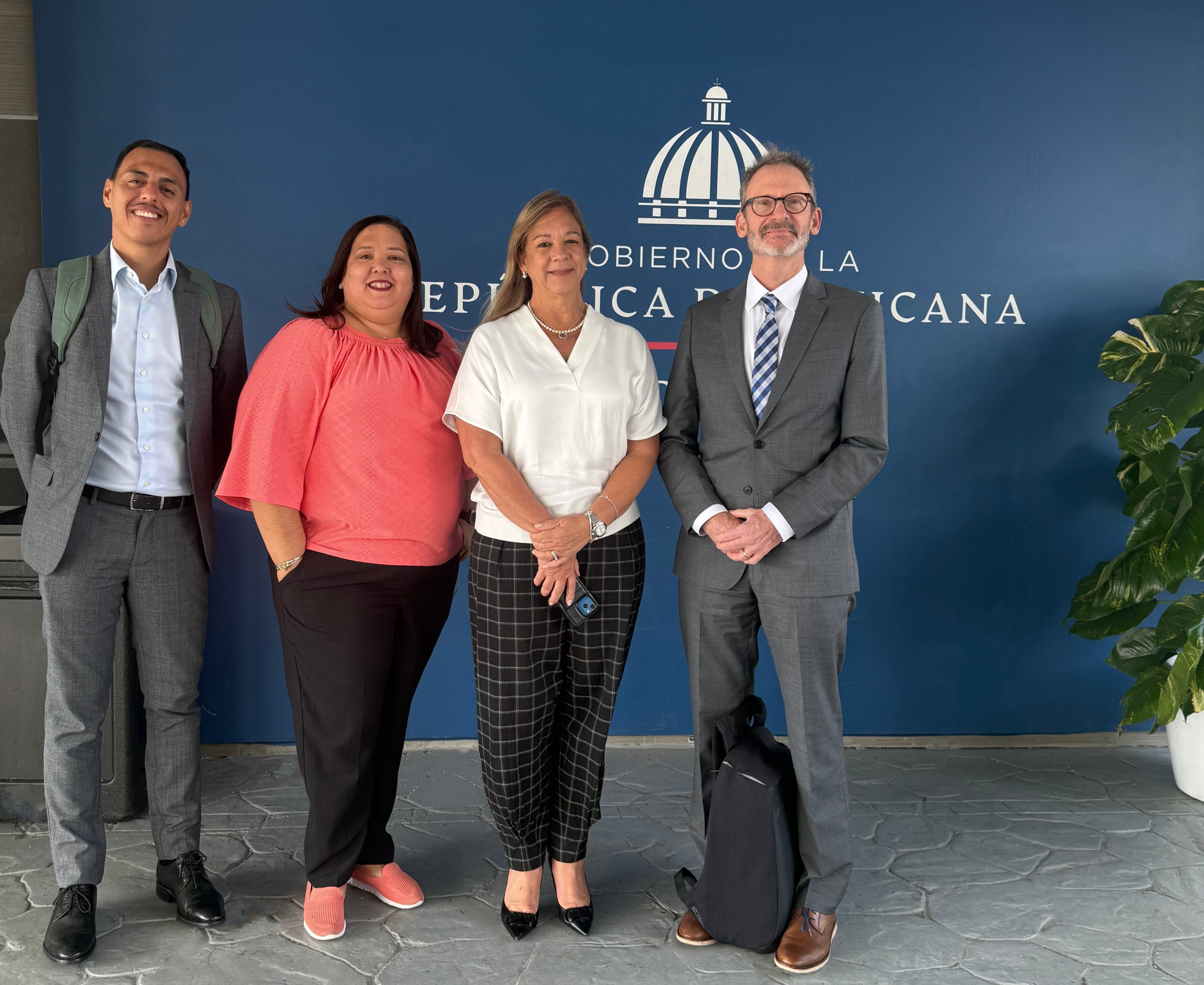
From left to right
Fillip Dias (PFSCM Senior Client Account Manager), Nydia Yacaira Rosario Chireno (Supervisor of Medicines and Supplies),
Dr. Monica Thormann (Program Coordinator – STI HIV and Hepatitis Division), Edward Wilson (PFSCM Director)
For more than a decade, PFSCM has partnered with the Ministry of Health of the Dominican Republic (DR) to strengthen national supply chains and safeguard access to essential health products.
What distinguishes sustainable supply chains is not a single procurement cycle — but the ability to continuously improve performance over time.
PFSCM’s collaboration with the DR began through support to national HIV programs, ensuring reliable access to affordable, quality-assured antiretrovirals (ARVs). Beyond procurement, PFSCM provided technical assistance and in-country logistics support to strengthen downstream distribution and support the adoption of multi-month dispensing for eligible patients — improving continuity of care.
Today, that foundation continues to drive measurable results across broader health products.
In 2025 alone, PFSCM supported procurement strategies that reduced the cost of key antiretroviral treatments by 13%, generating more than $666,000 in savings while maintaining access to quality-assured products from a competitive global supplier base.
Performance review to performance gains
During a recent visit to the Dominican Republic, PFSCM met with Ministry of Health leadership to review 2025 performance and align on 2026 priorities.
These discussions focused on structured performance analysis, lessons learned, sourcing strategies, and logistics optimization – ensuring that improvements are embedded directly into the next procurement cycle.
2025 Outcomes:
Key outcomes from 2025 include:
- 13% price reduction for Dolutegravir/Lamivudine/Tenofovir (TLD) antiretroviral therapy, generating USD $666,491 in savings
- Strengthened supplier competition, with 13 WHO- and USFDA-approved manufacturers participating in the market
- Improved logistics planning, including optimized pallet configuration for ocean shipments
- Better arrival scheduling to avoid weekend storage charges
- Reinforced documentation processes to support seamless customs clearance
These improvements demonstrate how structured procurement strategies and supply chain optimization can deliver both financial efficiencies and improved supply security.
Left to right
Fillip Dias (PFSCM), Kevin Ruiz (Logenix), Edward Wilson (PFSCM)
Long-term partnerships allow supply chains to move beyond transactions — turning performance insights into measurable efficiencies and long term value.
— Fillip Dias, Senior Client Account Manager
Delivering value across the supply chain
Beyond pricing efficiencies, PFSCM works proactively to reduce avoidable operational costs and shipment risk. During the visit, discussions with logistics partners focused on optimizing pallet configuration for ocean shipments, aligning arrival schedules to prevent weekend delivery and unnecessary storage charges, and strengthening documentation processes to ensure seamless customs clearance.
These upstream adjustments may appear operational in nature – but they directly translate into reduced waste, improved predictability, and stronger supply continuity.
PFSCM’s integrated model — spanning quality assurance, strategic sourcing, procurement optimization, logistics coordination, and digital supply chain tools — is designed to deliver value at every stage.
By strengthening market competition, refining freight planning, and applying performance data to procurement strategy, PFSCM helps partners:
- Maximize value for money
- Reduce procurement and logistics risk
- Minimize waste and avoidable costs
- Improve supply reliability
- Build sustainable national systems
For governments, this means stronger operational efficiency and resilience.
For donors, it means measurable return on investment and risk mitigation.
For communities, it means uninterrupted access to essential prevention and treatment products.
Sustained collaboration, long-term Impact
As PFSCM and the Ministry of Health plan for 2026, the focus remains on continuous improvement — integrating lessons learned, strengthening market engagement, and reinforcing resilient supply systems.
Long-term partnerships create the space for disciplined performance management. Disciplined performance management delivers measurable public health impact.