

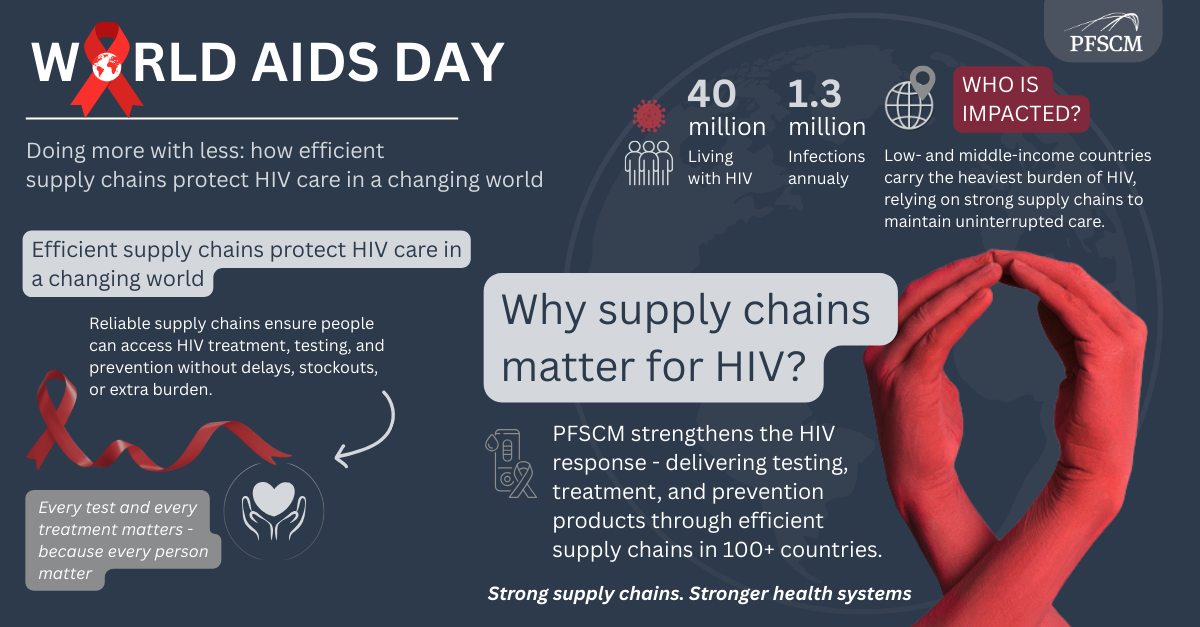
Across the globe, more than 40 million people are living with HIV. Behind every one of these individuals is a healthcare system – and a supply chain – that must work reliably so that treatment, testing, and prevention tools are always within reach.
Today, many HIV programs face growing pressure. Funding is tightening, priorities are shifting, and disruptions threaten the continuity of services people depend on. In this environment, supply chains must operate more efficiently.
For the Partnership for Supply Chain Management (PFSCM), doing more with less means every order and shipment needs to be as cost-effective and efficient as possible.
PFSCM saves the Dominican Republic, on average $1 million (equivalent to 6,500 additional first-line HIV treatments) annually on the procurement of HIV products
Strong foundations in a shifting landscape
PFSCM grew out of one of the most challenging moments in global health, the height of the HIV crisis. Countries needed not just products, but systems they could depend on, and they needed them rapidly and on a large scale.
Over the years, PFSCM has helped strengthen these systems by reducing costs, improving availability, minimizing waste, and establishing reliable mechanisms that enhance health outcomes.
Today, a few foundational principles continue to guide us:
- Quality and value for money, ensuring safety, and affordability in every purchase.
- Demand aligned with reality, not assumptions, to avoid stockouts and overstocking.
- Shorter, more efficient supply chains that reduce lead times and improve long-term impact.
Since 2019, PFSCM has delivered tens of thousands of shipments of HIV and co-infection products to more than 100 countries – always with a focus on efficiency and uninterrupted care.
HIV rapid diagnostic test (RDT) kits are one of PFSCM’s core product portfolios, for which we have a long-standing procurement strategy that has enabled us to consistently provide quality and affordable supplies to more than 78 countries over the past three years. Concurrently, the demand for self-test kits – including blood-based assays – has accelerated, driven by the adoption of RDT dual tests that facilitate integrated screening. PFSCM has excelled in this area too and has been supporting countries with the procurement of self-test kits for several years
Engineered access: resilience and optimization in the global ARV market for LMICs
The ARV market continues to show resilience, with no major changes in supplier capacity or global availability. With increasing focus on simplified and long-acting therapies, the dominance of optimal DTG-based regimens continues to shape market demand, with adult treatment costs below $45 per person per year. PFSCM maintains a strong and diverse supplier base, reducing procurement risk and supporting multi-year planning for clients.
This steady market environment enables:
- predictable lead times, reducing the need for costly expediting,
- minimize risk of stockouts,
- simplified forecasting, and
- greater cost efficiency due to fewer emergency orders and more competitive procurement cycles.
For national HIV programs, a stable ARV supply means they can maintain uninterrupted treatment services and implement long-term strategies such as multi-month dispensing and decentralized distribution models.
For patients, stability translates into continuous treatment access and improved adherence outcomes.
Despite growing volatility across global supply chains, core ARV markets remain stable, thanks to decades of effective market-shaping and sustained generic competition. Nevertheless, emerging ARV products – including long-acting options and pediatric formulations – continue to experience variability and delays in access. PFSCM continues to monitor market trends to ensure this stability is maintained.
Diagnostics: diverse today, evolving tomorrow
PFSCM’s diagnostics portfolio also remains diverse. Supporting countries that continue to rely on rapid tests, viral load tools, and early infant diagnosis products to guide timely, accurate testing and treatment adoption.
At the same time, the HIV diagnostics landscape is beginning to evolve. Several manufacturers are developing multiplex (dual and triple) rapid tests that combine screening for HIV, syphilis, and hepatitis – an emerging approach recognized by WHO to strengthen integrated HIV/STI testing strategies.
PFSCM is tracking these developments to help countries adopt new technologies thoughtfully and without disruption.
PFSCM has more than 6,200 ready-to-procure health products in our digital catalog, including more than 175 HIV products like laboratory equipment, molecular diagnostics, including point-of-care (PoC) and near PoC for HIV Viral load (VL) testing and early infant diagnosis (EID) and reagents, and consumables
Efficiency with a human purpose
For PFSCM, an efficient supply chain is not just a logistics achievement – it is a lifeline. When products move predictably:
- patients don’t face long journeys only to find empty shelves,
- health workers spend more time on care and less on crisis management, and
- Ministries can stretch limited budgets to reach a greater number of people.
Our approach continues to focus on:
- Load optimization and packaging innovations to drive cost efficiencies and reduce waste,
- fast and efficient duty waiver approvals and quick customs clearance,
- multi-month dispensing to reduce patient burden,
- strong forecasting to minimise waste,
- robust cold chain systems to protect product quality, and
- predictability that builds trust in health care systems.
Did you know?
We have worked closely with major pharmaceutical suppliers to initiate cartonless packing and multi-month dispensing of ARVs for our clients. By eliminating the secondary packaging and pooling orders, more treatments can be shipped in the same amount of space, thereby reducing freight costs and the overall total landed cost. An example includes a large order for Zambia where cartonless packaging led to a 58% reduction in the number pallets, a 55% reduction in the estimated of required containers and most critically, a 55% corresponding reduction in the freight cost.
Another example is for the Dominican Republic, where three to six months of dispensing reduced clinic visits and patient burden, improved ARV adherence and retention, resulting in 10% cost savings on product value and decongested health facilities. Cartonless packaging further led to a 35% to 45% reduction in volume, lowering costs and CO2 emissions.
Looking ahead
The HIV response is evolving, and supply chains must evolve with it. That means proactive planning, strong partnerships, and systems designed for resilience – not just cost savings.
PFSCM remains committed to:
- anticipating changes in ARVs and diagnostics,
- building waste-aware and efficient procurement practices, and
- helping countries strengthen local and regional supply chain capacity.
When supply chains are reliable, people can rely on their health systems – and the path to ending HIV becomes clearer and more achievable.

Every test, every treatment, and every shipment matters – because every person matters.
PFSCM has been supporting three of its longstanding clients with HIV supply chain services for more than 10 consecutive years each. We have been serving two of the clients since 2009, offering end-to-end procurement and logistics services for a wide range of HIV prevention, testing, and treatment products. For the third client, we have been contracted as a procurement services agent since 2014, managing forecasting, validation, fulfillment, and end-to-end logistics to ensure donated pediatric HIV medicines reliably reach recipients in ten Sub-Saharan African countries.